A wheel chock stabilizer prevents trailer movement by locking tires in place. The right model depends on your axle width, the gap range it covers, and whether it uses a simple wedge or a scissor mechanism for durability.
Best overall: X-Chock Wheel Stabilizer offers a versatile adjustment range and reliable zinc-coated steel construction, making it the most trusted choice for balancing tandem tires and reducing sway. Best for wide axles: BAL 28024 X-Tended provides the necessary reach for larger gaps between tires, ensuring you get the same locking stability on wide tandem axles as standard models. Best simplicity: **MAXXHAUL Rubber Chock** is the ideal choice for anyone wanting a basic, no-tool solution that resists weather and provides high-friction grip on almost any surface.
This guide is for RV owners looking to secure their parked trailers and improve stability while living inside.
How We Picked
To build this list, we compared 48 different product listings available on Amazon. We prioritized items that provided clear technical specifications, such as exact adjustment ranges, material composition, and included accessories like ratcheting wrenches. Products were selected based on their ability to solve common parking issues like tire shifting and trailer rocking. We excluded options that lacked clear compatibility details or failed to provide information on construction materials.
All 10 products side by side — scroll sideways to see every column.
| Top Pick | Best for Tire Movement | Best for Large Trailers | Best for Single Axles | Best for Various Terrain | Best for Corrosion | Best for Quick Setup | Best for Quick Stops | Best for [Heavy Duty | ||
| Preview |  | 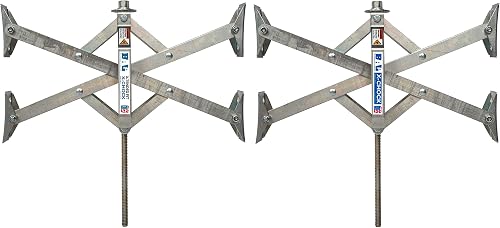 |  |  |  |  |  |  |  |  |
|---|---|---|---|---|---|---|---|---|---|---|
| Product | X-Chock Wheel Stabilizer | BAL 28024 X-Tended | Stromberg Carlson T-Chock | BAL 28020 Tire Chock | PAULINN Camper Stabilizer | MaxxHaul 50627 Stabilizer | Original Camper Stabilizer | MAXXHAUL Rubber Chock | Tevlaphee Universal Lock | Camper X Wheel Chocks |
| Brand | BAL | BAL | Stromberg Carlson | BAL | PAULINN | MAXXHAUL | EPOARTIST | MAXXHAUL | Tevlaphee | Rvdeaa |
| Best for | Best Overall | Best for Tire Movement | Best for Large Trailers | Best for Single Axles | Best for Various Terrain | Best for Corrosion | Best for Quick Setup | Best for Quick Stops | — | Best for Heavy Duty |
| The listing says | Made in USA zinc-coated steel Reduces tire shift and sway | Prevents tire shifting Made in United States | Stabilizes travel trailers and campers Works with tandem axle configurations | Single axle locking chock Outer length 23" extended / 16.5" retracted | Matches clearances from 3.5" to 12" X-shaped design distributes load | Fits campers, trailers, and RVs Expands from 3.5" to 12" | Adjusts from 3.5" to 11.5" Installs in under 20 seconds | Solid molded rubber construction Approximately 8" x 4" x 6" size | High strength steel plate Bright yellow and red visibility | Compatible with electric drill Extends up to 17 inches |
| More information | Check Price on Amazon | Check Price on Amazon | Check Price on Amazon | Check Price on Amazon | Check Price on Amazon | Check Price on Amazon | Check Price on Amazon | Check Price on Amazon | Check Price on Amazon | Check Price on Amazon |
1. X-Chock Wheel Stabilizer
Best for: Standard tandem axle travel trailers.
This stabilizer reduces tire shift by applying opposing force between your tandem tires. The zinc-coated steel construction resists rust, maintaining performance even in harsh, wet outdoor environments.
Measure your axle gap before purchasing. If your gap is between 1-3/8″ and 10″, this unit provides a secure fit.
The kit includes a 3/4″ ratchet wrench with a comfort bumper for quick setup. Tighten the unit until you feel firm resistance against both tires to ensure maximum balance. If you park in public areas, the lockable design supports the optional 28015 pad lock to prevent theft.
The manufacturer backs this American-made product with a limited lifetime warranty. Always confirm your specific tire spacing, as this tool is ineffective on single-axle trailers or those with gaps outside the specified range.
Pros
- Rust-resistant zinc-coated steel.
- Includes convenient ratchet wrench.
- Supports optional security lock.
Cons
- Limited to 10″ maximum gap.
- Incompatible with single-axle trailers.
2. BAL 28024 X-Tended Fit X-Chock Tire Locking Chock
Best for wide tandem axle configurations, this model is engineered specifically for trailers with significant distance between the wheels. It leverages the natural movement of the tires to lock them firmly into place, creating a stable, rock-solid platform for your RV.
Measure the gap between your tires before purchasing. Using this model on a narrow setup prevents the mechanism from engaging, which leaves your trailer prone to shifting and negates the investment.
The set includes two heavy-duty steel chocks and a dedicated ratchet wrench for secure installation. While the ratchet simplifies the tightening process, ensure you apply enough tension to eliminate tire flex without over-extending the bolt.
Pros
- Engineered for wide axle gaps.
- Includes two heavy-duty steel chocks.
- Simple ratchet setup process.
Cons
- Incompatible with narrow axle gaps.
- Bulky frame requires specific clearance.
If you’re unsure of your spacing, check your trailer manual or measure the distance between the tire treads. If the gap is tight, choose the standard version to avoid a failed fit.
3. Stromberg Carlson JBP-T217.2 Tandem Axle T-Chock
Best for: Larger trailers and fifth wheels.
This heavy-duty stabilizer is built to withstand regular use and provides a firm lock against your axles. It is compatible with a variety of vehicles with a fit range of 2″ to 17″. The included wrench makes installation straightforward.
Measure the gap between your tires before buying. If your tires are spaced less than 2″ apart, this model won’t fit. If they exceed 17″, the scissor mechanism can’t reach both tires to create the necessary pressure.
Use the included wrench only until you feel firm resistance against the tires. This creates the tension required to stop the floor from shifting.
The robust construction is intended for those who park in diverse environments and need a reliable, long-term solution.
Pros
- Wide 2″ to 17″ range.
- Durable, heavy-duty construction.
- Reliable axle-locking pressure.
Cons
- Heavier than basic models.
- Unsuitable for tires spaced under 2″ or over 17″.
4. BAL 28020 Single Axle Tire Chock
Best for: Single axle trailer owners.
This chock is engineered specifically for single axle setups where you must prevent rolling. It offers an outer length of 23 inches when fully extended and 16.5 inches when retracted. This provides a secure fit for single wheels, locking the tire firmly in place with a maximum extension of 6.5 inches.
The inner length measures 16.5 inches at full extension, dropping to 10 inches when retracted. Always measure your tire gap before purchasing. If you own a tandem axle trailer, this tool will fail to stabilize the space between your tires.
If your trailer has two axles, look for a model designed to fit between the wheels. If you have a single axle, this heavy-duty metal construction provides the necessary immobilization. Use this device only on level or slightly sloped ground to ensure the locking mechanism maintains full pressure against the tire tread.
5. PAULINN Camper RV Wheel Chock Stabilizer 2 Sets
Best for: Varying terrain and parking conditions.
Made from cast iron, this stabilizer is built to handle significant torque. The X-shaped configuration distributes weight evenly across the tires, which helps prevent unwanted movement. Because the design features a unique pattern on both sides, it increases friction to ensure a firm grip on the tire. It fits wheel gaps between 3.5″ and 12″, making it quite versatile for different trailer models.
The package includes a storage bag and both a ratchet wrench and an electric screw head for faster installation. Always measure your specific clearance before purchasing to ensure a proper fit.
The anti-rust finish protects the unit during extended outdoor use. If you’re parking on uneven ground, the reinforced connections allow the chocks to endure various forces.
Pros
- Durable cast iron construction.
- Includes handy storage bag.
- Compatible with electric drills.
Cons
- 12″ maximum gap limit.
- Not suitable for gaps under 3.5″.
6. MaxxHaul 50627 Tandem Wheel Chock Stabilizers
Best for: Fast setup and teardown.
This scissor-style stabilizer expands from 3.5″ to 12″ to fit most standard tandem axle trailers. It features a durable coat finish designed to resist corrosion, which is helpful if you store your RV in humid or rainy areas. The kit comes with a pair of chocks and a ratcheting wrench.
The handle makes it easy to carry and position between the tires. Before purchasing, measure the gap between your tires. If your tires sit closer than 3.5 inches or further than 12 inches apart, this model won’t engage properly. Using it outside this range prevents the device from applying the necessary opposing force to stop wheel shift.
If you find the mechanism difficult to tighten, ensure the tires aren’t resting on uneven terrain that could cause the scissor arms to bind.
Pros
- Easy-to-use scissor mechanism.
- Corrosion-resistant finish.
- Includes a pair of chocks and a wrench.
Cons
- Fixed 3.5″-12″ range.
7. Original Camper Stabilizer
Best for: Quick, tool-free adjustment.
This stabilizer stops rocking motion in travel trailers by locking the wheels in place. It fits gaps from 3.5″ to 11.5″ and uses heavy-duty gauge steel to ensure stability. When installed correctly, it eliminates 90% to 100% of the movement felt while walking inside your RV.
Installation is simple and requires no drilling. You simply place the device between your tires and expand the jack using the provided wrench. The entire process takes less than 20 seconds per side.
If your trailer sits on ground where the tire gap exceeds 11.5″, this model won’t reach. You must measure your specific tire spacing before purchasing. Avoid the mistake of relying on these chocks for primary leveling; they’re designed to stop motion, not to lift or level a trailer on steep slopes.
Pros
- Very fast setup time.
- Heavy-duty steel build.
- One-year warranty included.
Cons
- 11.5″ maximum extension.
- Not a substitute for leveling jacks.
8. MAXXHAUL Solid Rubber Wheel Chock 2-Pack
Best for: Basic safety and quick stops.
If you want the simplest solution possible, this rubber chock is a reliable choice. It measures 8″ x 4″ x 6″ and is made from solid, heavy-duty rubber that resists crushing and weather damage. The built-in handle allows for easy placement without tools.
The high-friction surface is designed to grip various terrains, including gravel and pavement. This isn’t a stabilizer that locks between wheels; it’s a passive stop, so it won’t prevent trailer sway or rocking as well as the scissor-style chocks.
If you’re parking on a steep incline, use a pair of chocks per tire to ensure the vehicle remains stationary. Many users make the mistake of using only one chock on a slope, which can lead to creeping if the surface is slick.
Pros
- No tools required for use.
- Weather and oil resistant.
- Solid, durable rubber build.
Cons
- Doesn’t reduce trailer sway.
- Requires manual placement behind each tire.
9. Tevlaphee Universal Wheel Lock Heavy Duty Security Trailer Wheel Lock
Best for: Anti-theft security.
This is a security lock rather than a standard stabilizer. It’s made from high-strength steel and features a soft coating to protect your wheel finish. It’s highly visible, which acts as a deterrent to potential thieves.
The lock is adjustable to fit wheel widths from 7 to 11 inches. Before purchasing, measure the width of your tire to ensure it falls within this range. If your tire is wider than 11 inches, this device won’t close securely around the wheel.
It isn’t meant for stabilizing the floor of your coach or stopping movement while you’re living inside the trailer. Using this as a leveling tool won’t provide the support needed to keep your vehicle steady.
Pros
- Strong steel construction.
- Highly visible theft deterrent.
- Soft coating protects wheels.
Cons
- Not for stabilization.
- Requires specific tire width measurements.
The unit includes three keys. If you lose all three, you’ll be unable to remove the clamp without professional assistance. Keep one key in a secure, separate location.
10. Camper X Wheel Chocks
Best for: Heavy-duty applications.
These stabilizers fit a wide range of 4″ to 17″ wheel distances. They’re built with thicker steel than many other models, aiming for extra durability and stability. The design is optimized for fast operation and can be used with an electric drill. If you want the fastest setup time available, use a drill to expand the fourth-generation mechanism.
The center point design uses reaction force against the tire to secure the trailer. These aren’t the best choice if you prefer a lightweight, manual-only tool without the option for power-drill assistance. If your trailer sits on uneven ground, the heavy-duty steel construction provides the necessary anti-corrosion resistance for long-term outdoor exposure.
Avoid using these on trailers with wheel gaps smaller than 4″ or larger than 17″. Exceeding these limits prevents the stabilizer from locking properly, which compromises the safety of your rig.
Pros
- Wide 4″-17″ fitment range.
- Compatible with electric drills.
- Thicker, heavy-duty steel construction.
Cons
- Heavier than standard chocks.
How to Choose in Sixty Seconds
Which stabilizer type do I actually need?
You must first measure the distance between your tandem tires. If your trailer has a standard gap, most scissor-style stabilizers will work well. If you have a wide-axle configuration, look for models specifically labeled for wider gaps, like the BAL 28024 X-Tended. Never guess the distance; always use a tape measure while the trailer is on level ground. If you only need to stop the trailer from rolling on a driveway, simple rubber chocks are sufficient. If your goal is to stop the floor from shaking when people walk around, you need a locking scissor-style stabilizer that exerts outward pressure against the tire treads.
Should I choose steel or rubber?
Steel scissor-style stabilizers are the best for reducing sway and movement. They lock the wheels together, which creates a rigid connection that prevents the trailer from rocking. Rubber chocks are better for basic safety, such as preventing a rollaway while the trailer is parked on a slope. If you choose steel, ensure it has a rust-resistant coating, as the National Highway Traffic Safety Administration emphasizes the importance of maintaining trailer equipment to ensure safe towing and parking. Rubber is naturally resistant to weather but doesn’t provide the structural “lock” that steel stabilizers offer. Always match the material to your primary goal: sway reduction or simple roll prevention.
Does the installation method matter?
Yes, the installation method affects how often you’ll actually use the stabilizer. Models that include a ratcheting wrench are usually the easiest to use. Some newer models, like the Camper X Wheel Chocks, allow the use of an electric drill, which can save time if you move your trailer frequently. If you struggle with hand strength, look for models that specifically mention compatibility with drills or have long, ergonomic handles on the wrench. Avoid complex systems that require multiple steps or extra tools you don’t already own. Simple, fast-acting designs are usually better because they encourage consistent use every time you park.
Related guides
Frequently Asked Questions
What does it take to maintain these stabilizers?
Maintaining these stabilizers requires regular inspection of moving parts. For steel models, lubricate the adjustment rod threads if they become stiff, and keep rubber chocks clean of debris. Replace any components showing signs of significant deformation or rust to ensure the locking mechanism remains functional.
Can I use these stabilizers on soft ground?
Scissor-style stabilizers are designed for hard surfaces like pavement, gravel, or concrete. They may sink or lose grip on soft ground where tires settle. Always level your trailer before installation, as these devices are intended to lock wheels rather than serve as primary leveling tools.
Do these work with every type of trailer?
These stabilizers are designed for tandem axle trailers by spreading force between two tires. They will not work on single axle trailers because there is no second tire to provide opposing force. Always verify your axle configuration and the manufacturer’s fitment chart before ordering to ensure compatibility.
Is the simplest model on the list enough?
The MAXXHAUL Rubber Chock is a passive device that prevents rolling on slopes. It provides a physical block for the tire but does not stop trailer sway. If your primary concern is interior stability while parked, you should choose a scissor-style stabilizer instead of a simple rubber chock.
Closing
For most RV owners, the X-Chock remains the most reliable pick due to its durable, rust-resistant steel construction. If you need more reach for a wide-axle trailer, the BAL 28024 X-Tended is an excellent alternative that provides similar locking security.
Before making your final choice, measure the exact distance between your tires. Models like the Stromberg Carlson T-Chock or Rvdeaa stabilizers accommodate gaps up to 17 inches, while others like the standard X-Chock or Nilight models may only reach 10 inches. If your gap is 3.5 inches or less, ensure you choose a compact model, as some wider stabilizers won’t retract far enough to fit.
Always inspect your stabilizers for wear before each trip. A common mistake is failing to tighten the mechanism fully, which leaves the trailer prone to rocking; if the floor still moves when you walk inside, the pressure is insufficient. Taking a moment to secure your trailer properly prevents rollaways and eliminates movement. Whether you use a ratchet wrench or an electric drill, ensuring a firm, opposing force between your tires makes your stay significantly more comfortable.