Choosing a solar charge controller for your RV means balancing your battery bank voltage, your total solar panel wattage, and how much monitoring data you want on your smartphone. These devices vary primarily by their peak voltage capacity, their built-in versus optional wireless connectivity, and their ability to handle different battery chemistry types.
Best overall: Victron SmartSolar MPPT offers reliable performance with built-in Bluetooth and intelligent algorithms that track maximum power even in partial shade, ensuring your batteries stay healthy throughout your travels.
Best for heavy DIY setups: **Renogy 60A MPPT** provides a high 150V input limit that allows for larger solar arrays, making it ideal for those building extensive off-grid power systems in larger vehicles.
Best for simple mobile control: LiTime 30A MPPT features built-in Bluetooth for easy remote monitoring and a clear LCD interface, making it perfect for users who want connectivity without buying extra parts.
This guide is for RV owners looking to optimize their battery charging efficiency using MPPT technology.
How We Picked
To select these controllers, we compared 32 different Amazon listings based on technical specifications and functional features. A product earned a place only if it provided clear data on maximum voltage input, battery compatibility, and its specific MPPT tracking efficiency. We prioritized units that include explicit support for LiFePO4 batteries, as these are increasingly common in modern RV builds. Products were excluded if they lacked essential safety certifications or if their key features, such as Bluetooth, required opaque or unreliable third-party modules. We focused on the manufacturer’s stated capabilities, such as heat dissipation designs and temperature compensation, to ensure each recommendation serves a distinct need in an RV power system.
All 10 products side by side — scroll sideways to see every column.
| Top Pick | Best for Physical Display | Best for Large Setups | Best for Heat Dissipation | Best for High Voltage | Best App Control | Best for WiFi Monitoring | Best for Lithium Recovery | Best for High Power | Best for Fast Charging | |
| Preview |  |  |  |  |  |  |  |  | 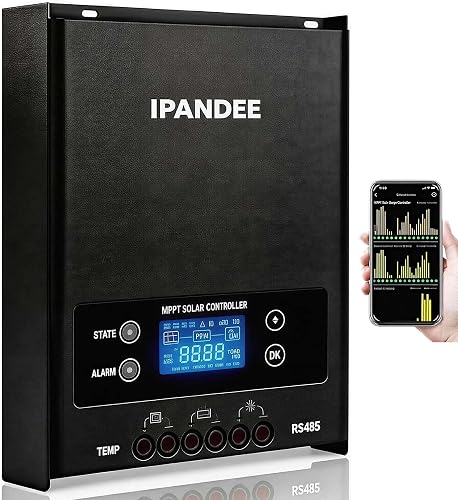 |  |
|---|---|---|---|---|---|---|---|---|---|---|
| Product | Victron SmartSolar MPPT | Renogy Rover MPPT | Renogy 60A MPPT | LiTime 30A MPPT | PowMr 60A MPPT | BougeRV 40A MPPT | ECO-WORTHY 60A MPPT | 30A MPPT | 100A MPPT | Victron Energy BlueSolar MPPT |
| Brand | Victron Energy | Renogy | Renogy | Litime | PowMr | BougeRV | ECO-WORTHY | Qigreesol | ipandee | Victron Energy |
| Best for | Best Overall | Best for Physical Display | Best for Large Setups | Best for Heat Dissipation | Best for High Voltage | Best App Control | Best for WiFi Monitoring | Best for Lithium Recovery | Best for High Power | Best for Fast Charging |
| The listing says | Optimizes energy conversion and [battery longevity Fast tracking](https://vehicleetc.com/best-rv-battery-monitor-bluetooth-sensor/) for maximum power output | Compatible with 12V/24V panels up to 800W 99.9% tracking and 98% conversion efficiency | Supports 150V maximum solar input Operates from -31℉ to 113℉ | 99% tracking efficiency Built-in Bluetooth for remote control | Auto-detects 12V-48V battery systems Over 98.1% tracking efficiency | App monitoring via ChargePro 2.0 Six integrated safety protections | 99.5% tracking and 98% conversion efficiency Bluetooth and WiFi for remote monitoring | Auto-detects 12V/24V/36V/48V systems 99% tracking efficiency with 3-stage charging | Multi-curve MPPT technology 100A continuous output | Multi-stage charging for various battery types Fast tracking for maximum power output |
| More information | Check Latest Price on Amazon | Check Latest Price on Amazon | Check Latest Price on Amazon | Check Latest Price on Amazon | Check Latest Price on Amazon | Check Latest Price on Amazon | Check Latest Price on Amazon | Check Latest Price on Amazon | Check Latest Price on Amazon | Check Latest Price on Amazon |
1. Victron Energy SmartSolar MPPT 100V 30 amp 12/24-Volt Solar Charge
Best for: Reliable, high-efficiency solar management in any RV.
The Victron SmartSolar MPPT is known for its fast tracking technology. This helps you get the most energy from your panels, even when trees or clouds partially block the sun. The built-in Bluetooth allows you to check your system’s status directly from your phone.
You can also synchronize multiple controllers to work together, which is a great feature if you expand your solar array later. It’s a solid choice for those who want a set-it-and-forget-it system with reliable software.
If you have a complex setup, use the VictronConnect app to configure battery presets or update firmware. You can also set specific alarms to tailor the system to your needs. If you notice your battery voltage dropping too low, the intelligent load output will automatically disconnect your devices to prevent damage.
If you’re unsure if your system is optimized, check the 30-day performance history within the app. This data reveals if your panels are truly capturing every ray of sunlight. If you use multiple controllers, ensure they’re synchronized to act as one unit. This prevents conflicting charge stages and protects battery longevity.
Pros
- Built-in Bluetooth for easy mobile monitoring.
- Fast tracking technology maximizes energy harvest.
- Multiple units can synchronize for larger systems.
Cons
- No large built-in screen for data.
2. Renogy Rover 30A 12V/24V Auto DC Input MPPT Solar Charge
Best for: RV owners who want a physical display.
The Renogy Rover MPPT includes an LCD screen that shows your system data without needing a phone. It’s engineered to handle harsh conditions, featuring temperature compensation that protects your batteries in extreme heat or cold. The unit operates safely between -40°F and 149°F, auto-adjusting to prevent charging failures in desert heat or freezing climates.
This controller also has specific modes for different battery types, including lithium. It features exclusive reactivation technology to safely revive deeply discharged lithium batteries. If you use lead-acid batteries, the 4-stage charging process—Bulk, Absorption, Float, and Equalization—extends their lifespan. It’s a practical choice for those who prefer to see their stats on the wall of their RV.
If your system includes high-draw components like pumps or motors, this controller handles the necessary capacitive surges. You can also schedule DC loads like lights or fans directly through the timer. Note that the Bluetooth capability requires a separate BT-2 module, which you must purchase if you want remote app monitoring via the Renogy DC Home App.
Pros
- Clear, easy-to-read integrated LCD screen.
- Wide operating temperature range for safety.
- Supports various battery types, including lithium.
Cons
- Bluetooth module sold separately.
3. Renogy 60A MPPT Solar Charge Controller 12V/24V/36V/48V Auto
Best for: Large, complex DIY solar power setups.
The Renogy 60A MPPT is designed for high-capacity systems. Its 150V maximum solar input allows you to wire up to six 200W panels in series. This approach simplifies your wiring and significantly reduces installation complexity.
It’s built to operate in extreme temperatures from -31°F to 113°F. It includes low-temperature protection to keep your lithium batteries safe, extending their overall lifespan. While it’s excellent for larger builds, its size and capacity are overkill for a small campervan using only one or two panels. If your setup requires fewer than 60 amps, you’re paying for power you can’t use.
Pros
- High 150V solar input capacity.
- Built-in low-temperature battery protection.
- Supports large 12V to 48V systems.
- Certified to FCC, RoHS, and CE standards.
Cons
- Bluetooth module sold separately.
- Requires the BT2 module for smartphone monitoring.
The controller is compatible with Gel, Sealed, Flooded, and Lithium batteries, making it a flexible choice for diverse energy storage needs.
4. LiTime 12V/24V 30A MPPT Solar Charge Controller Bluetooth
Best for: Users who want integrated Bluetooth included.
The LiTime 30A MPPT stands out because it includes Bluetooth inside the unit. You don’t need to buy extra parts to see your data on a smartphone. The die-cast aluminum case helps keep the device cool during operation, which reduces power loss.
It’s compatible with LiFePO4 and lead-acid batteries, with specific charging modes for each. Use the provided copper wire connectors during installation to increase the contact area, which improves current transmission.
This unit isn’t suitable for systems that exceed its 30A charging current limit. If your solar array produces more than this, you’ll overwhelm the controller. Always verify your total amperage before connecting.
Pros
- Bluetooth module is built-in.
- Sturdy aluminum case for heat dissipation.
- Includes dedicated LiFePO4 charging mode.
- Covered by AIG Product Liability Insurance.
Cons
- Limited to 30A charging current.
5. PowMr MPPT 60A Solar Charge Controller 12V 24V 36V 48V
Best for: Systems requiring high voltage versatility.
The PowMr 60A MPPT handles a wide range of battery voltages, from 12V up to 48V. It features a smart cooling fan that turns on when the device exceeds 104°F, ensuring it stays quiet during light use. The unit achieves over 98.1% tracking efficiency, significantly outperforming standard PWM controllers.
The LCD screen provides real-time information, and the unit is designed to be compact for easy wall mounting. If you’re using sealed, gel, or flooded batteries, the device adjusts automatically. However, if you use lithium batteries, you must manually adjust the parameters to match your specific voltage, as lithium chemistry is less stable than lead-acid. Always disconnect the PV input before changing these settings. If the controller displays night mode unexpectedly, reset it by holding the last button for five seconds while only the battery is connected.
Pros
- Supports system voltages up to 48V.
- Smart cooling fan for stable performance.
- Compact size for easy installation.
Cons
- Lithium settings require manual adjustment.
- PV input must be disconnected before programming.
6. BougeRV 40A MPPT Solar Charge Controller 12V/24V/36V/48V APP Control
Best for: Those who prioritize app-based control.
The BougeRV 40A MPPT uses the ChargePro 2.0 app for monitoring and configuration. It’s built with a heavy-duty heat sink and internal potting compounds to reduce vibrations, which is helpful if you travel on bumpy roads. The app provides a 15-foot signal range to adjust charge voltage and current settings.
The controller features a negative ground design, making it compatible with most standard RV electrical systems. It provides six specific protections, including safeguards against short-circuits, over-temperature, and reverse polarity. You must connect your energy storage unit to the controller first. This step allows the device to recognize the system voltage and wake up the display.
It isn’t for users who don’t have a smartphone, as the app is the primary way to manage advanced settings. If your setup requires specific lead-acid temperature compensation, ensure the sensor is properly installed to utilize the unit’s thermal management.
Pros
- App control via ChargePro 2.0.
- Internal potting reduces vibration damage.
- Negative ground design fits most RVs.
- 99% conversion efficiency.
Cons
- Advanced settings require smartphone app.
- Requires manual battery connection sequence.
7. ECO-WORTHY 60A MPPT Solar Charge Controller with Bluetooth & WiFi
Best for: Users wanting both Bluetooth and WiFi.
The ECO-WORTHY 60A MPPT stands out by including both Bluetooth and WiFi modules. Use the Bluetooth connection for real-time monitoring within 33 feet, or rely on the WiFi module for long-distance access. You can track 30 days of performance history and adjust parameters directly from your smartphone.
This controller handles 12V, 24V, 36V, or 48V systems automatically. It achieves 99.5% tracking efficiency, ensuring high power output even when clouds obscure the sun. Connect your DC equipment directly to the unit, choosing between normal, optical, or fixed-time light control modes.
The device protects your battery health through specific charging profiles: 4-stage for lead-acid and 2-stage for LiFePO4, including an activation function for the latter. It also guards against short circuits, high temperatures, and reverse connections.
Pros
- Includes both Bluetooth and WiFi modules.
- Supports multiple DC load control modes.
- Automatic system voltage detection.
Cons
- You will need to link a pair of modules together to achieve full connectivity.
8. MPPT Solar Charge Controller 30 Amp 12V 24V 36V 48V
Best for: Recovering deeply discharged lithium batteries.
The 30A MPPT by Qigreesol specializes in “0V battery recovery.” If your LiFePO4 battery shuts down due to deep discharge, this controller can safely wake it up using solar power. It works only when paired with a certified BMS protection board.
Always connect your system in this specific order: first the battery, then the load, and finally the PV panel. Disconnecting in reverse prevents damage. If you mix these steps, you risk damaging your controller or battery.
It provides detailed data through the Noi Solar App and allows for eight programmable load modes. This is a great choice for those who are worried about their battery management system cutting them off. Note that it’s rated IP20, meaning it must be installed in a dry, ventilated indoor compartment like an RV electrical bay.
Pros
- Features 0V lithium battery recovery.
- Detailed monitoring via dedicated app.
- Eight programmable load control modes.
Cons
- Indoor installation only (IP20).
- Requires 2.4GHz WiFi for remote checks; 5GHz networks aren’t supported.
9. 100A MPPT Solar Charge Controller
Best for: High-power off-grid and marine systems.
The ipandee 100A MPPT is built for massive solar arrays. It supports up to 250V input and 5200W of solar capacity on 48V systems. Unlike controllers that throttle power under heat, this unit uses a reinforced design to deliver a full 100A continuously.
If you’re running a 12V system, limit your array to 1300W; use 2600W for 24V, 3900W for 36V, and 5200W for 48V. Exceeding these ratings risks system failure.
This controller includes RS485 support and Modbus protocol, making it ideal for users who want to integrate power into home-automation setups. However, it’s likely too large for a standard weekend RV. If your project requires simple, plug-and-play operation, this unit’s complexity may lead to configuration errors. Stick to smaller models unless you specifically need the 250V input for longer panel strings.
Pros
- Massive 5200W solar capacity.
- Advanced RS485 and Modbus integration.
- No throttling under heavy loads.
Cons
- Overkill for basic RV setups.
10. Victron Energy BlueSolar MPPT Solar Charge Controller 75V
Best for: Users seeking Victron quality in a compact, essential design.
The Victron Energy BlueSolar MPPT is a reliable, entry-level option from a trusted brand. It offers the same fast tracking technology as the SmartSolar range in a streamlined, essential package. This controller is compatible with AGM, Gel, LiFePO4, and flooded lead-acid batteries, ensuring versatility across different setups.
It’s perfect if you want Victron performance without paying for built-in Bluetooth. If you prefer wireless monitoring, you must purchase a separate Bluetooth dongle to pair the device with your smartphone via VictronConnect. If you require out-of-the-box wireless access, choose the SmartSolar range instead.
The device uses intelligent algorithms to maximize energy harvesting even when solar panels are partially shaded. This ensures your batteries reach a full charge in the shortest possible time. This is the best choice for a user who wants to start small and upgrade their monitoring later.
Pros
- Trusted Victron tracking technology.
- Simple, effective design.
- Bluetooth upgradeable via dongle.
Cons
- No built-in Bluetooth included.
How to Choose in Sixty Seconds
Which solar charge controller features actually matter for an RV?
The most important feature is the MPPT (Maximum Power Point Tracking) technology itself, which extracts more energy from your panels than older PWM controllers. You should also ensure the controller is compatible with your specific battery bank voltage (12V, 24V, or 48V) and chemistry (Lithium, AGM, or Gel). For RVs, a controller with temperature compensation is a major plus, as it protects batteries during hot summer days or freezing nights. Finally, consider if you want a built-in screen or app-based monitoring. For a reliable, safe connection, always follow the National Electrical Code guidance regarding wire sizing and overcurrent protection to ensure your solar installation remains safe and efficient throughout its lifespan.
Should I prioritize built-in Bluetooth?
Built-in Bluetooth makes daily life with your solar system much easier. It allows you to see exactly how much power you’re generating and your current battery percentage without needing to crawl into a dark electrical compartment to read a small LCD screen. However, if you’re on a budget or prefer a more “analog” setup, you can choose a unit without Bluetooth, like the Victron BlueSolar, and add a dongle later if you decide you need it. If you choose a controller with Bluetooth, verify if the app is available for your phone’s operating system. Most modern controllers support both iOS and Android, but it’s always safer to confirm before you finalize your purchase.
How much solar power can my controller handle?
You must match the controller’s maximum wattage and voltage input to your solar array’s specifications. Look at your solar panel’s Open Circuit Voltage (Voc) and multiply it by the number of panels in your string. If this value exceeds the controller’s maximum voltage input rating, you’ll damage the controller. Similarly, check the maximum solar input wattage the controller can handle for your specific battery voltage. Using a controller that’s too small for your solar array will cause it to throttle power, wasting energy that your panels could have provided. Always review your solar panel’s data sheet to confirm these numbers before connecting them to your new controller.
The Victron SmartSolar MPPT and the LiTime 30A MPPT stand out as the top choices for most RV owners. The Victron provides proven reliability and advanced synchronization for those who want a premium system, while the LiTime is an excellent all-in-one solution that includes Bluetooth for a more straightforward setup experience. Before you finalize your decision, double-check your solar panel’s total wattage and your battery bank’s voltage to ensure the model you pick can handle your specific hardware. Once you have checked your numbers, you can confidently install your chosen controller and start enjoying more efficient solar harvesting on your next trip.
Frequently Asked Questions
What does it mean if my controller displays a fault code?
A fault code typically signals issues with wiring, battery voltage, or solar input. For instance, the Qigreesol 30A MPPT controller displays codes in its app to help identify reversed polarity or low battery voltage. If errors persist, consult your manual to identify specific conditions like short circuits or over-temperature.
Can I mix different brands of solar panels with these controllers?
You can mix different brands of solar panels if their electrical characteristics are compatible. The Renogy Rover MPPT works with various panels, provided your total array’s Open Circuit Voltage does not exceed the controller’s maximum input rating. Keep panel strings consistent to ensure the MPPT algorithm tracks the power point accurately.
Do I need to buy a separate Bluetooth module for these controllers?
Whether you need an extra module depends on your specific controller model. Some units, like the LiTime 30A MPPT, feature built-in Bluetooth, while others, such as the Victron Energy BlueSolar MPPT, require a separate dongle for wireless monitoring. Always check the product listing to confirm if the module is included.
Is the simplest controller on this list enough for my RV?
For standard RV solar arrays, a controller like the Victron Energy BlueSolar MPPT effectively manages battery charging. You only require high-capacity 100A models if you are powering a large motorhome or off-grid cabin. As long as the controller matches your battery voltage and array wattage, it will charge your batteries efficiently.
Conclusion
Once you’ve picked the right unit for your setup, it’s time to double-check your wiring connections before heading out on your first trip. Don’t rush the installation, as taking your time now will ensure your batteries stay healthy for years. You’ll be glad you did when you’re camping off-grid under the stars.