Selecting a dual strap battery box for your RV requires balancing physical space, environmental protection, and secure mounting. You are deciding between rugged, enclosed containers that shield against road debris and simple tray systems that prioritize airflow. The right pick depends on whether you value heavy-duty security or easy access.
Best overall: Camco Double Battery Box, because it provides a complete, compliant, and durable enclosure that fits common dual-battery setups while including all necessary hardware for a stable, secure installation. Best for GC2 batteries: Camco 55374 Double Box, as it’s specifically designed to accommodate these batteries while meeting recognized safety standards and including a manufacturer warranty for long-term reliability. Most durable construction: Metal Dual Battery Box, since its steel enclosure offers superior protection against outdoor elements and includes lockable security features for fixed, permanent, or high-security storage applications.
This guide is for RV owners who need to secure their dual-battery systems safely for travel.
How We Picked
We compared 32 different Amazon listings to identify which battery storage solutions meet strict safety and organizational requirements. To earn a place here, each product had to provide clear interior dimensions, confirm the type of batteries it supports, and include all necessary mounting hardware like straps or brackets. Products were excluded if they lacked essential mounting details or failed to provide clear specifications for their construction materials. Our selections focus on items that prioritize secure, compliant installation to ensure your batteries remain stable on the road.
All 10 products side by side — scroll sideways to see every column.
| Top Pick | Best for GC2 Batteries | Best for Security | Best for Group 27 | Best for Strap Replacement | Best for Coastal Use | Best for Vibration | Best for Stainless Steel | Best for Extreme Temps | Best for Single 6V | |
| Preview | 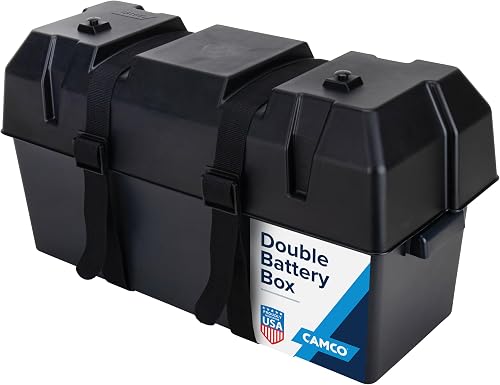 | 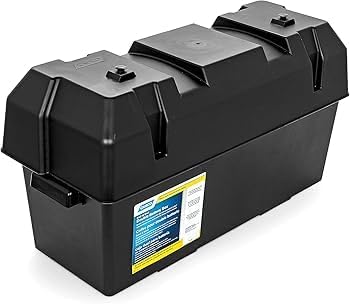 |  |  |  |  |  |  |  |  |
|---|---|---|---|---|---|---|---|---|---|---|
| Product | Camco Double Battery Box | Camco 55374 Double Box | Metal Dual Battery Box | Seachoice Dual Battery Tray | GOODTIMES Battery Strap Kit | EXVITAL Battery Tie Down | RV Battery Box Strap | Trailer RV Dual Battery Box | Attwood PowerGuard Battery Box | Camco RV Marine Battery Box |
| Brand | Camco | Generic | YeeJinHong | SEACHOICE | Goodtimes | EXVITAL | QFGasre | peastorm | attwood | Camco |
| Best for | Best Overall | Best for GC2 Batteries | Best for Security | Best for Group 27 | Best for Strap Replacement | Best for Coastal Use | Best for Vibration | Best for Stainless Steel | Best for Extreme Temps | Best for Single 6V |
| The listing says | Fits batteries up to 21-9/16" x 7-7/16" x 11-9/16" Contains and protects dual batteries | Holds two 6V GC2 or 12V Group 24/24M batteries Corrosion-resistant polypropylene construction | Holds two 12V batteries; 21.56 x 8.33 x 11.77 in interior Steel enclosure with black protective coating | Replacement for old or cracked battery trays Holds 2 group 27 deep-cycle marine batteries | Includes 78-inch lashing straps, cam buckles, and mounts Durable 600D webbing, cut to desired length | Zinc alloy cam buckle prevents rust Sturdy nylon webbing with smooth edges | Heavy-duty polypropylene webbing with robust buckles Fastens battery box to stop shifting and vibration | Stainless steel metal construction Lockable cover with handles and cable holes | Fits Group 27 batteries up to 10.5 inches high Acid-resistant polypropylene, impact-tested -20°F to +120°F | Protects 6V battery from collisions and contaminants Holds (1) 6V battery |
| More information | Check Price on Amazon | Check Price on Amazon | Check Price on Amazon | Check Price on Amazon | Check Price on Amazon | Check Price on Amazon | Check Price on Amazon | Check Price on Amazon | Check Price on Amazon | Check Price on Amazon |
1. Camco Double Battery Box
Best for: Standard RV dual-battery setups.
This box keeps two batteries safely contained and protected from the elements while you travel. Its heavy-duty polymer construction is built to last, and it includes built-in handles that make it much easier to move when you need to perform maintenance. It also fits a variety of common battery sizes, which adds a lot of flexibility compared to the more rigid Metal Dual Battery Box.
Measure your battery bank before purchasing. The internal space is limited to 21-9/16″ (L) × 7-7/16″ (W) × 11-9/16″ (H). If your batteries exceed these dimensions, the lid won’t seat correctly, compromising the weather protection. The box is designed to house two 6V Group GC2 batteries or two 12V Group 24/24M batteries.
The included hardware, such as the eight screws and four strap clamps, ensures a professional-grade installation that stays put on rough roads. If you prioritize regulatory compliance, note that this unit meets U.S. Coast Guard CFR 183.420 and ABYC E-10.7 specifications when housing two 6V Group GC2 batteries. This box isn’t for users who need to frequently remove their batteries for charging, as the secure screw-down design prioritizes stability over quick access.
Pros
- Meets official safety standards
- Includes all installation hardware
- Durable polymer build quality
Cons
- Requires tools for removal
- Size isn’t adjustable
2. Camco 55374 Double End-to-End Battery Box – Fits Two 6V
Best for: Owners using 6V GC2 batteries.
This box handles two 6V GC2 or two 12V Group 24/24M batteries in a compact, end-to-end configuration. The vented design manages gas buildup, which is essential for battery safety and long-term health. If you’re mounting this in an RV or marine environment, the heavy-duty, corrosion-resistant polypropylene construction provides the necessary durability to withstand harsh exposure.
You must verify your battery type before installation. When using two 6V GC2 batteries, this unit meets U.S. Coast Guard CFR 183.420 and ABYC E-10.7 compliance standards. If you’re using 12V batteries, these specific certifications don’t apply.
The kit includes two straps and four clamps with screws for a secure, stable mount. Don’t rely on the lid for theft prevention; it’s designed for easy access rather than high-security storage. If you prioritize security, you’ll need to add an external locking mechanism.
The product includes a limited one-year manufacturer warranty. Remember that all warranty claims remain at the discretion of the manufacturer.
Pros
- Meets Coast Guard and ABYC standards for 6V setups
- Corrosion-resistant polypropylene
- Vented for safety
- Includes mounting straps and clamps
Cons
- No locking mechanism
- Compliance standards vary by battery type
3. Metal Dual Battery Box for Two 12V Batteries
Best for: High-security and permanent battery storage.
If you want the toughest protection available, this steel enclosure is the clear choice. The black protective coating shields your batteries from rain, dust, and road debris far better than standard plastic alternatives. It also features integrated cable ports with rubber grommets, which keeps your wiring tidy and protects cables from chafing against the metal edges.
The lockable cover is a major advantage for people who want to limit access to their battery system while parked in public areas. This box isn’t for those who need a lightweight solution, as the steel construction adds significant weight that you must account for during your installation.
Pros
- Lockable steel construction
- Protective cable routing ports
- High impact resistance
Cons
- Noticeably heavier than plastic
- Requires careful fit measurement
4. Seachoice Dual Battery Tray With Poly Strap
Best for: Minimalists using Group 27 batteries.
This tray system is the perfect replacement if you already have a mounting location and just need to secure two Group 27 deep-cycle marine batteries. It’s a simple, no-nonsense solution that focuses on keeping your batteries from sliding without the bulk of a full box. It meets all NMMA requirements, which gives you confidence that it will hold up during marine or RV use.
The poly strap with a quick-release buckle makes checking your batteries quick and easy compared to the screw-down lids of the Camco Double Battery Box. If your installation area is exposed to the elements, this tray is a poor choice. The open design leaves the terminals and casing fully vulnerable to rain or road splash. Use this tray only when your batteries are stored inside a protected cabin or a dedicated, covered compartment.
Measure your available floor space before purchase, as the unit requires a footprint of 14-1/8 inches long by 12-3/8 inches wide. If your battery casing isn’t a Group 27 size, the fit will be loose and unsafe.
Pros
- Quick-release buckle strap
- Meets NMMA safety requirements
- Durable, low-profile design
Cons
- Open design lacks protection
- Limited to Group 27
5. GOODTIMES Battery Box Hold-Down Strap Kit
Best for: Replacing worn-out or weak straps.
If your existing battery box is still in good shape but the straps have frayed or the buckles have rusted, this kit is the ideal fix. The use of stainless steel 316 for the buckles and mounts is a major upgrade, as it prevents rust in saltwater or damp environments. The 78-inch length is very generous, allowing you to cut the nylon webbing to fit almost any box size.
The 600D webbing is thick and anti-UV, designed to resist degradation under constant sun exposure. If your equipment slides during transit, use these straps to lock your battery box, tool box, or fuel containers firmly in place.
This kit isn’t for people who don’t have a drill, as you must secure the four stainless steel eye strap mounts to your floor or tray using the nine included screws. If you’re installing these on a boat, the 316-grade stainless steel is essential to prevent corrosion. If you’re working in a tight compartment, remember that the webbing is easily cut; always leave an extra two inches for tensioning.
Pros
- Rust-resistant stainless steel hardware
- Very long, customizable strap length
- Durable, anti-UV nylon material
Cons
- Requires drilling for installation
- Straps require manual cutting
6. EXVITAL Battery Tie Down Strap Hold Down Kit
Best for: Corrosion-prone marine or coastal environments.
This kit provides a pair of 48-inch straps with high-quality zinc alloy cam buckles that are designed to resist rust. A unique feature is the protective pad placed under the buckle, which prevents the metal from scratching your battery casing or the box itself. It’s a versatile kit that works just as well for securing coolers as it does for batteries.
The nylon webbing is tight and firm, giving it a premium feel. This kit isn’t for those who need to secure extremely large battery setups, as the 48-inch length is shorter than the 78-inch option provided by the GOODTIMES Battery Strap Kit.
Pros
- Protective pad prevents scratching
- Corrosion-resistant zinc alloy buckles
- High-quality, firm nylon webbing
Cons
- Shorter than other strap options
- Buckle design is less robust
7. RV Battery Box Strap
Best for: Multi-point securing.
These straps are made from heavy-duty polypropylene and are designed for high tensile strength, making them very reliable for holding down heavy battery boxes. At 59 inches, they offer a good middle-ground length that fits most standard RV battery storage locations. They fold flat easily, which is helpful if you carry spares in your tool kit for emergencies.
If you’re securing a standard battery box, wrap the strap around the tray and pull the buckle until the tension eliminates all movement. If you notice the battery shifting during turns or over bumps, the strap is likely too loose; tighten it immediately to prevent terminal damage or power loss.
These straps work for cars, SUVs, and boats, but they’re best suited for environments where you can inspect the buckle periodically for wear. This product isn’t for those who need stainless steel hardware, as the buckle material isn’t specified for extreme rust resistance. Use these for internal or covered storage rather than exposed marine decks to ensure the longest lifespan for the webbing.
Pros
- Strong, abrasion-resistant material
- Easy, tool-free installation
- Value-focused bundle featuring a pair of power cells.
Cons
- No rust-proof hardware rating
- Basic buckle design
8. Trailer RV Marine Battery Box – 12V Waterproof Stainless Steel
Best for: Heavy-duty, weather-sealed dual battery systems.
This stainless steel box is built for those who prioritize extreme durability and weather protection. It’s naturally fireproof and waterproof, making it an excellent choice for mounting batteries in exposed areas under your trailer or boat. The inclusion of a lock and rubber-protected cable ports shows it’s designed for a permanent, secure installation.
Before buying, verify your batteries fit within the 22″ L x 8.5″ W x 11.5″ H maximum capacity. The box itself measures 22.25″ L x 8.7″ W x 11.75″ H. If your battery dimensions exceed these limits, the lid won’t close, compromising the waterproof seal.
This box isn’t for those sensitive to total weight, as the stainless steel construction is heavier than polymer alternatives. If you prioritize weight savings for a kayak or lightweight trailer, choose plastic. If you require a fireproof, rigid housing for a marine or heavy-duty RV setup, the metal construction provides the necessary protection. Use the included screws to anchor the unit through the reserved bottom holes to prevent shifting during transit.
Pros
- Stainless steel, fireproof construction
- Lockable lid included
- Rubber-protected cable routing
Cons
- Heavy metal construction
- Higher installation effort
9. Attwood PowerGuard Vented Marine Battery Box
Best for: Extreme temperature performance.
This box is specifically tested for performance in temperatures ranging from -20°F to +120°F, making it a reliable choice for year-round RV campers. The polypropylene material resists acid, which is vital for long-term battery health. Its heavy-duty strap is rated for 350 lbs of force, nearly four times the USCG requirement.
Measure your battery before purchasing. The interior space measures 13.06 x 6.9 x 10.5 inches. If your battery height exceeds 10.5 inches, the lid won’t latch, compromising the safety seal. Always check your battery group size; this unit is engineered exclusively for Group 27 batteries. Don’t attempt to force a larger unit inside, as the lid must vent gases properly to remain compliant with ABYC E-10 standards.
The vented design allows hazardous gases to escape while minimizing water intrusion. This box isn’t for users with dual-battery setups, as it holds only one battery.
Pros
- Rated for extreme temperatures
- Acid-resistant construction
- Extra-strong hold-down strap
Cons
- Single battery capacity only
- Requires precise fitment within 13.06 x 6.9 x 10.5 inch interior
10. Camco RV Marine Battery Box
Best for: Single 6-volt battery protection.
This box protects a single 6V battery from collisions and environmental contaminants. It’s made from a heavy-duty, corrosion-resistant polymer built for long-term outdoor use. It’s a popular choice for replacing a damaged box on an existing single-battery setup.
Before purchasing, measure your battery against the internal dimensions of 11 inches long, 7 3/8 inches wide, and 11 3/16 inches high. If your battery exceeds these specific measurements, it won’t fit. This box isn’t for owners who plan to upgrade to a dual-battery system later, as the interior is strictly sized for one unit.
The package includes one strap and two strap clamps with screws for secure mounting. It meets U.S. Coast Guard CFR 183.420 and ABYC E-10.7 specifications when used with a single 6V battery. If you’re operating in a marine environment, these certifications confirm the build quality meets necessary safety standards.
Pros
- Reliable, compliant construction
- Corrosion-resistant polymer material
- Simple, secure strap included
Cons
- Single battery capacity only
- No locking mechanism
How to Choose in Sixty Seconds
Measure Your Space
Before you buy, measure your batteries and your available storage area. Don’t rely on group sizes alone, as dimensions can vary between manufacturers. Always account for the space needed for terminals and cable routing. A common mistake is failing to measure the height of the battery terminals, which can prevent the lid from closing properly. If you find a box with an interior length of 21-9/16 inches but your battery is 22 inches, the lid won’t seat.
Material Durability
Consider the environment where your RV will travel. If you’re frequently driving on gravel roads or in salty coastal areas, a heavy-duty polymer or stainless steel box will offer the best protection. Polymer is lightweight and won’t rust, while stainless steel offers superior impact resistance and security. If you choose a metal box, look for one with rubber grommets for cable ports to help protect cables from contact with sharp metal edges. If you only need to keep the battery from shifting during light travel, a simple tray and high-quality nylon strap are often sufficient and much easier to work with for regular maintenance. If you choose a strap, ensure it’s rated for the weight of your battery; some nylon straps are rated for 350 pounds of force to ensure the battery remains locked in place.
Ventilation and Access
Batteries release gases during charging, so ventilation is essential for safety. Most high-quality boxes include vented lids to allow these gases to escape safely. If you choose a box, ensure the vents aren’t obstructed when you secure it in your RV. If you prefer a tray, you get excellent airflow, but you lose the protection against road debris. Think about how often you need to access your batteries. If you perform frequent checks, a quick-release strap system is much more convenient than a screw-down lid. If the batteries are tucked away and rarely touched, a secure, lockable box is usually the better long-term choice. When installing, always use the provided hardware, such as strap clamps and screws, to ensure the unit meets U.S. Coast Guard CFR 183.420 specifications.
Frequently Asked Questions
Do I need a vented battery box for my RV?
Yes, ventilation is necessary for lead-acid batteries because they release hydrogen gas while charging. A vented box allows these gases to escape, preventing dangerous pressure buildup. Ensure the box vents remain unobstructed by mounting brackets or other equipment during installation.
Can I use a metal battery box for any battery type?
You can use a metal box, but you must prevent short circuits by ensuring battery terminals cannot touch the conductive walls. High-quality metal boxes include rubber-protected cable ports to prevent wire chafing. Always verify the battery is strapped firmly to prevent shifting during travel.
Are all battery straps the same length?
No, strap lengths vary significantly between products. The GOODTIMES Battery Strap Kit provides 78 inches for larger setups, while the EXVITAL Battery Tie Down offers 48 inches for compact installations. Always ensure the buckle material is appropriate for your environment, such as stainless steel for saltwater exposure.
How do I ensure my battery box is compliant?
Look for boxes that meet U.S. Coast Guard CFR 183.420 and ABYC E-10.7 specifications to ensure compliance. Reputable manufacturers like Camco and Attwood clearly state these certifications on their product listings. These standards provide a reliable safety benchmark for both marine and non-marine battery installations.
Closing
For most RV owners, the Camco Double Battery Box is the most reliable choice because it balances durability, safety compliance, and ease of installation in a single package. It meets U.S. Coast Guard and ABYC specifications when used with two 6V Group GC2 batteries.
If you require a more robust, long-term solution for extreme conditions, the Metal Dual Battery Box offers superior protection and security. Choose the metal option if you need a lockable cover to limit unwanted access or require integrated cable ports to keep wires organized and shielded from sharp edges.
Always measure your batteries, terminals, and cable clearance before buying, as group size alone doesn’t guarantee a fit. Once you have chosen the right box for your dimensions, ensure your cables are routed through protective grommets and the straps are tightened securely. Regularly checking these connections is the best way to prevent vibrations from loosening terminals while on the road.