Choosing the best rv roof vent fan remote setup means balancing convenience with how you use your vehicle. These fans differ mainly by their control options, such as voice or app integration, and their ability to handle weather automatically. A good choice depends on whether you value high-tech features or simple, reliable airflow.
Best overall: MAXXAIR Maxxfan Deluxe, which provides an all-in-one solution with a built-in rain cover that allows for ventilation even while driving or in poor weather conditions. Best for frequent travelers: MAXXAIR Maxxfan Plus, because it offers versatile operation choices including manual or remote-control electric opening, plus a rain sensor that protects your interior automatically. Best for quiet comfort: RV Roof Vent Fan, as it features an ultra-quiet brushless motor that runs at 25dB, making it ideal for use in bedrooms and sleeping areas.
The rest of this guide is for anyone looking to upgrade their camper ventilation for better comfort and easier operation.
How We Picked
We compared 48 different Amazon listings to find the most capable options for your vehicle. Each product had to provide clear technical specifications, such as fan speeds, power requirements, and compatibility with standard roof openings. We excluded models that lacked essential information about their installation or operation methods. Our focus remained on features that directly impact user experience, such as rain sensors, remote functionality, and motor type.
All 10 products side by side — scroll sideways to see every column.
| Top Pick | Best for Versatile Use | Best for Quiet Bedrooms | Best for App Control | Best for Precise Speed | Best for Extreme Weather | Best for Roof Upgrades | Best for Skylight Design | |||
| Preview |  | 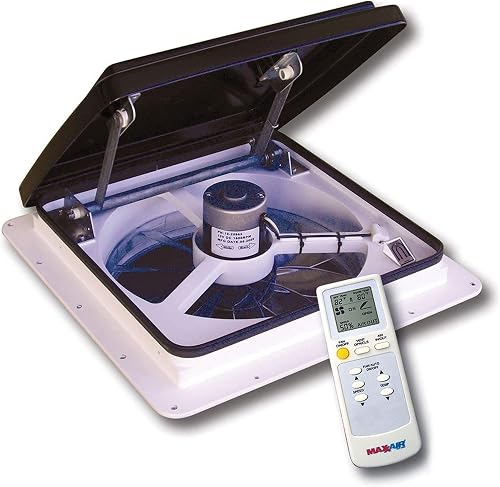 |  |  |  |  |  |  |  |  |
|---|---|---|---|---|---|---|---|---|---|---|
| Product | MAXXAIR Maxxfan Deluxe | MAXXAIR Maxxfan Plus | RV Roof Vent Fan | Heavy Duty Voice Control | RV Roof Vent Fan | Camco Skylight Vent Fan | EROMMY RV Roof Vent | Reversible 12V/24V Vent | RVMATE Roof Vent Fan | Caravan Skylight Vent Fan |
| Brand | MAXXAIR | MAXXAIR | 2012 | 2012 | Starvent | Camco | EROMMY | Airtaxi | RVMATE | Frezon |
| Best for | Best Overall | Best for Versatile Use | Best for Quiet Bedrooms | — | Best for App Control | — | Best for Precise Speed | Best for Extreme Weather | Best for Roof Upgrades | Best for Skylight Design |
| The listing says | Vent, fan, and cover in one unit 10-speed reversible fan with thermostat | 10-speed intake and exhaust fan Tool-free installation for FANMATE vent cover | Brushless motor with 25dB noise level Reversible airflow with 4-speed settings | Brushless motor with 3-blade airflow Voice control ready with included remote | 10 manual and automatic temperature settings Electric lift with manual crank backup | High-performance RV roof vent fan Reversible intake and exhaust modes | 12V DC, 30W roof-mounted unit 10-speed fan with reversible airflow | Brushless motor with 35,000-hour lifespan 0.15W standby power and 25dB noise | 14-inch by 14-inch fan with remote Fits 1-1/4-inch to 2-1/4-inch thick roofs | Manual handle for opening and closing Push-button airflow direction control |
| More information | Price on Amazon | Price on Amazon | Price on Amazon | Price on Amazon | Price on Amazon | Price on Amazon | Price on Amazon | Price on Amazon | Price on Amazon | Price on Amazon |
1. MAXXAIR Maxxfan Deluxe Vent
Best for: All-weather ventilation and driving use.
The MAXXAIR Maxxfan Deluxe combines a vent, fan, and cover into one unit. Its built-in rain cover is a major advantage, as it lets you keep the fan running during rain or even while driving. The built-in rain cover provides a comprehensive ventilation solution.
If you find yourself frequently leaving your RV unattended, the thermostat feature is the deciding factor. Set your desired temperature, and the 10-speed fan will adjust automatically to maintain that climate. This prevents your interior from becoming stifling during the day without requiring manual intervention.
Compared to the RVMATE Roof Vent Fan, this unit includes a pre-installed rain shield for continuous use. It’s a solid choice for those who want a complete, “set it and forget it” system. This fan isn’t for those who prefer a separate, lightweight cover that can be removed or swapped easily.
Pros
- Built-in rain protection
- 10-speed reversible fan
- Fits standard 14″x14″ openings
- Two-year limited warranty
- Easy tool-free screen maintenance
Cons
- No app control
- Higher profile on roof
2. MAXXAIR Maxxfan Plus High Powered 10-Speed RV Intake and Exhaust
Best for: Versatile control options.
The MAXXAIR Maxxfan Plus offers both manual and remote-control electric opening options. Its rain sensor is a key feature, as it automatically closes the lid when it detects moisture to keep your cabin dry. The ceiling-mounted controls provide a reliable backup if you misplace your remote or prefer tactile adjustments.
Choose the manual opening model if you prioritize simplicity and lower power draw. Select the electric opening version if you want the convenience of remote adjustments from your bed or seating area. If you live in humid climates, the rain sensor is essential, as it prevents sudden interior water damage without requiring your intervention.
Unlike the Heavy Duty Voice Control fan, this model focuses on direct operation rather than smart voice assistants. It suits owners who want flexible control methods without needing a smartphone app or complex integration. If you specifically require voice-activated smart home features, this unit won’t meet your needs.
Pros
- Automatic lid closure
- High-powered ventilation
- Intake and exhaust modes
- Ceiling-mounted controls
- Tool-free cover mounting
Cons
- Cover sold separately
- Manual opening required for some tasks
3. RV Roof Vent Fan 14×14
Best for: Quiet bedroom environments.
This RV Roof Vent Fan is built for silence, with a brushless motor that keeps noise levels at or below 25dB. Its four-speed settings and timer modes allow for precise air management throughout the night. The durable ASA and PC housing is designed to withstand extreme temperatures from -30°C to 100°C.
If you’re installing this in a sleeping area, the brushless motor offers five times the lifespan of standard units. Use the 60-to-240-minute timer modes to ensure the fan shuts off after you fall asleep. This prevents unnecessary battery drain while maintaining comfort.
The rain sensor provides a critical safety feature for unattended vehicles. If you’re parked in an area with unpredictable weather, the lid closes automatically to prevent water damage. However, don’t rely on this if you require more than four speed settings; those seeking granular airflow control may find the fixed speeds restrictive.
The unit fits standard 14-inch (356×356mm) openings, making it a direct replacement for most campers and motorhomes.
Pros
- Ultra-quiet operation
- Long-lasting brushless motor
- Four timer modes
- Wide temperature range
- Includes rain sensor
Cons
- Limited to a small selection of speeds
- No app control
4. Heavy Duty Voice Control
Best for: Modern smart-home enthusiasts.
The Heavy Duty Voice Control fan integrates with smart assistants, allowing you to change settings without leaving your bed. You can adjust speed, timers, or light color through voice commands or the included remote. It features a multi-color lighting system, which is a unique addition for setting the mood: use Warm White for reading, Amber to deter insects, Red for preserving night vision, or Cool Blue for a modern aesthetic.
The reinforced housing is 1mm thicker than standard models, providing extra durability against road vibration. While other models are only quiet at low speeds, this brushless motor maintains a “Whisper Quiet” level even at the highest setting.
When placed against the MAXXAIR Maxxfan Deluxe, this model offers much more advanced control features like voice commands and LED lighting. It’s perfect for those who want a modern, futuristic feel in their RV. This fan isn’t for users who prefer a simple, traditional manual interface. If you value silence during sleep, the brushless design prevents the motor noise that often causes insomnia.
Pros
- Voice control ready
- Multi-color LED lights
- Reinforced ABS housing
- 1-8 hour timer
- Reversible airflow
Cons
- Complex setup for some
- Voice control requires assistant
5. RV Roof Vent Fan 10 Speed 12V Thermostat Rain Sensor
Best for: App-based control and integration.
The Starvent 12V fan offers 10 manual speeds and automatic temperature-regulated settings. This allows you to customize airflow precisely. You can manage the dome opening via electric power or use the manual crank if you lose battery.
The unit fits standard 14″ x 14″ roof openings. It accommodates roof thicknesses between 1.16″ and 5.5″.
A built-in rain sensor provides automated protection. It closes the dome when moisture is detected and resumes operation once the sensor dries. This prevents interior water damage during unexpected storms.
You control the device through a remote or the dedicated mobile app. Use the timer function to schedule operation, which improves energy efficiency by preventing the fan from running unnecessarily.
This model is ideal for tech-focused owners who prefer digital monitoring. If you prioritize simplicity over software integration, the manual backup is a necessary secondary step that may feel cumbersome. Avoid this unit if your RV lacks a compatible roof thickness or if you prefer to avoid smartphone-dependent hardware entirely. Proper installation ensures the rain sensor remains clear of debris for consistent, worry-free performance.
6. Camco RV Skylight Vent Fan
Best for: Basic, efficient cabin ventilation.
The Camco Skylight Vent Fan is designed for straightforward performance in campers and travel trailers. It offers reversible intake and exhaust modes, which allow you to pull in fresh air or push out hot, stale air. This makes it useful for removing kitchen odors or bathroom humidity. The wireless remote allows you to adjust airflow direction and speed from anywhere in the cabin without reaching for the ceiling.
If you’re replacing an existing unit, measure your roof opening first. This fan fits standard 14” by 14” openings, making it a direct swap for most popular camper models.
This model focuses on essential airflow tasks. It’s ideal for those who want a reliable, no-nonsense fan for their bathroom or kitchen. This fan isn’t for users who want advanced features like voice control, rain sensors, or timer functions.
Pros
- Wireless remote included
- Reversible airflow modes
- Energy-efficient design
- Easy to install
- Quiet 12V operation
Cons
- No rain sensor
- No timer function
7. EROMMY RV Roof Vent
Best for: Precise speed regulation.
The EROMMY RV Roof Vent features a wide range of airflow settings, allowing for very fine control over your ventilation. The built-in thermostat lets you set a temperature between 59°F and 95°F, and the unit will work to maintain it. It also includes a 5A slow-blow fuse for added electrical protection.
If you’re replacing an existing unit, confirm your roof opening measures exactly 14″ x 14″. This standard size ensures a flush fit, but failing to verify your specific cutout dimensions often leads to leaks or improper sealing. Always check your current opening before purchasing to avoid the need for modifications.
When compared to the RV Roof Vent Fan by 2012, this model offers more speed levels for those who want to dial in the exact amount of air movement. It’s perfect for users who want to avoid sudden gusts of air.
Use the 433MHz wireless remote to adjust speed, reverse airflow, or open the lid without reaching the ceiling. The temperature memory function recalls your last setting, which saves time during frequent stops. This unit isn’t for those who prefer a simpler, limited-speed interface or require smartphone app integration.
Pros
- Variable speed control
- Temperature memory
- Thermostat integration
- Built-in fuse protection
- Reversible airflow
Cons
- No app control
- Basic remote interface
8. Reversible 12V/24V Vent
Best for: Extreme weather and heavy use.
The Reversible 12V/24V Vent by Airtaxi utilizes a brushless motor that lasts 35,000 hours, providing five times the lifespan of standard models. Its 0.05s response time for rain sensing is 300% more sensitive than traditional sensors, ensuring the unit seals in just 2.8s.
If you travel through diverse climates, rely on its aerospace-grade 304L stainless steel transmission and silicone gaskets. These components maintain a 0.45MPa sealing pressure, tested to withstand environments from -40°F to 250°F. If you frequently encounter salt spray or extreme temperature swings, this build is essential to prevent interior water damage.
Use the negative pressure ventilation mode when the unit is closed to manage moisture without wasting power. The system draws only 0.15W in standby, making it ideal for long-term off-grid storage where energy conservation is a priority.
Avoid this unit if you only require a basic exhaust fan for mild, predictable weekends. The precision engineering is designed for cross-country durability rather than simple airflow. If you prioritize long-term reliability over lower initial complexity, the 5-year unlimited warranty and self-lubricating hinges provide the maintenance-free operation required for heavy, year-round use.
Pros
- High-speed rain sensor
- Dual voltage support
- Extreme temperature range
- 5-year warranty
- Brushless motor efficiency
Cons
- More complex installation
- High-end feature set
9. RVMATE 14×14 RV Roof Vent Fan
Best for: Compact, straightforward replacement.
The RVMATE Roof Vent Fan is designed as a direct replacement for standard 14″x14″ openings. It comes with all necessary installation materials, including putty tape, which makes the setup process easier for beginners. The one-piece frame is designed to prevent leaks and resist UV damage.
Measure your roof thickness before starting. This unit fits roofs between 1-1/4″ and 2-1/4″ thick. When installing, use an awl or nail to align the corner pre-drilled holes before driving in your screws. Skipping this step often leads to misaligned holes and a compromised seal.
Unlike the Starvent RV Roof Vent Fan, this unit focuses on an easy, all-inclusive installation package. It’s a great choice for those upgrading an old, cracked, or damaged vent. This model isn’t for users who want advanced features like smart app control or auto-thermostat modes. Use button A for fresh air intake and button B to expel odors. If you’re driving or trying to sleep, the quiet motor allows for continuous operation without disruptive noise.
Pros
- Includes installation materials
- UV-resistant finish
- Leak-proof frame design
- Simple remote operation
- Fits standard openings
Cons
- Fewer speed settings
- No rain sensor
10. 15.75″ RV Caravan Roof Vent RV Fan 12V Skylight
Best for: Skylight-style integration.
The Caravan Skylight Vent Fan by Frezon uses a 10-blade design to provide stable and quiet airflow. It features a copper core motor for better efficiency and long-term reliability. The remote control allows for easy switching between intake and exhaust modes without manual effort.
Operate the lid by turning the handle clockwise to open the cover and counterclockwise to seal it shut. If you need to clear smoke or odors quickly, use the remote to toggle through the various airflow intensities. The bidirectional airflow lets you choose between pulling fresh air in or exhausting stale air out.
Because this unit lacks an automatic rain sensor, you must manually close the lid before a storm begins. Failing to do so leaves your interior vulnerable to water intrusion. If you prioritize automated protection during sudden weather shifts, look for a model with a built-in sensor.
It’s a solid choice for those who want a balance of performance and quiet operation.
Pros
- 10-blade fan design
- Pure copper motor
- Multiple speed settings
- Reversible airflow
- Remote included
Cons
- No rain sensor
- Manual lid handle
How to Choose in Sixty Seconds
Prioritize Your Controls
The biggest difference between these fans is how you interact with them. If you want convenience, look for models with mobile app integration or voice control, such as the Heavy Duty Voice Control or the Starvent model. If you prefer simplicity, a standard wireless remote is often enough. Before buying, confirm if your chosen model also includes a manual backup handle, as this is vital if your remote battery dies or the electronics fail while you’re away from home.
Check Weather Protection
Automatic rain sensors are essential if you often leave your vehicle unattended. Sensors like the one found on the Airtaxi fan react to moisture and close the lid instantly. Always check the response time and the material quality of the seals to ensure long-term reliability. If you don’t want to rely on sensors, consider an all-in-one unit with a built-in rain cover, such as the MAXXAIR Maxxfan Deluxe, which lets you leave the vent open even during heavy rain.
Consider Motor Efficiency
Modern brushless motors are superior to standard motors because they use less power and last longer. Look for a fan that offers multiple speed settings, as this allows you to balance airflow with energy consumption. If you plan to use the fan while boondocking, prioritize models that mention low standby power usage to conserve your battery life.
The MAXXAIR Maxxfan Deluxe remains the top choice for its reliable, all-in-one design that handles rain without needing extra hardware. For those wanting more modern control, the Heavy Duty Voice Control fan provides excellent smart features. To get started, measure your current roof opening to ensure it matches the standard 14″x14″ size used by these models.
Related guides
- Mounting Solar Panels on Rv Roof Without Drilling: Easy, Damage-Free Methods
- 10 Best RV Vent Pipe Cap Replacements for Durable Roof Sealing
- 10 Best RV Roof Vent Fan 12v Models for Efficient Airflow
Frequently Asked Questions
Do these fans fit all RV roof openings?
Most listed fans fit the standard 14″x14″ RV roof opening. Models like the RVMATE and EROMMY are built for this size. Always check your specific roof thickness before ordering, as some models require a thickness between 1.16″ and 5.5″ for a proper seal.
How do I clean the insect screen?
Maintenance keeps your airflow consistent. Models like the MAXXAIR Maxxfan Deluxe feature an interior insect screen that removes without tools for easy cleaning. Check your screen every few months or after long trips to ensure debris does not clog the mesh and reduce fan efficiency.
Can I install these fans by myself?
Many units, like the RVMATE, include putty tape for straightforward installation. If you are comfortable with hand tools, you can often replace a vent fan yourself. If you lack experience with roof sealing, hire a professional to ensure the unit remains leak-free.
What happens if the power goes out?
Most remote-controlled fans require 12V power to operate the lid and motor. Models like the Starvent and Frezon include a manual crank handle as a backup. Always verify your chosen model has this manual override feature if you are concerned about power loss.
Conclusion
Upgrading your ventilation setup makes a world of difference during those hot summer trips. Once you’ve picked the right model, don’t forget to check your roof seals before you start the installation. You’ll be much happier when you can finally enjoy a cool, breezy cabin without ever leaving your bed.