Choosing the right stabilizer is about how much movement you want to stop and how your RV is built. These tools fall into two main groups: scissor-style stabilizers that lock between tires to stop rocking, and basic chocks that sit against the tire to prevent rolling. Your choice depends on whether you have one axle or two.
Best overall: X-Chock Wheel Stabilizer, because it uses a simple, rust-resistant steel design that fits most tandem axle setups and includes a handy ratchet wrench for fast, secure setup. Best for wide axles: BAL 28024 X-Tended, which is designed specifically for those wider gaps between tandem tires where standard models might not reach or hold securely. Best for security: Trimax TCL65 Wheel Lock, which combines a physical chock with a locking mechanism to prevent both rolling and theft of your trailer while it’s left unattended.
The rest of this guide is for any RV owner looking to improve stability and safety while parked at a campsite.
How We Picked
We compared 48 different Amazon listings to find options that offer clear specifications and reliable features. Each pick had to list its adjustment range, material construction, and what is included in the box. We excluded any products that lacked clear details on their compatibility or that didn’t provide a description of their locking mechanism. Our selection focuses on products that provide consistent performance for different axle configurations.
All 10 products side by side — scroll sideways to see every column.
| Top Pick | Best for Wide Axles | Best for Travel Trailers | Best for Single Axles | Best for Wide Adjustment | Best for Trucks | Best for Quick Setup | Best for Anti-Theft | Best for All Weather | Best for Compact Storage | |
| Preview |  | 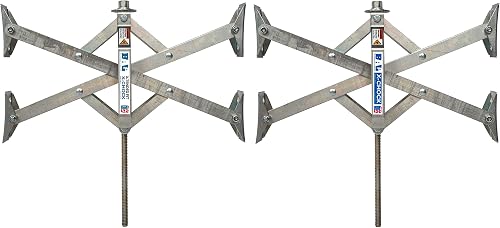 |  |  |  |  |  |  |  |  |
|---|---|---|---|---|---|---|---|---|---|---|
| Product | X-Chock Wheel Stabilizer | BAL 28024 X-Tended | Stromberg Carlson T-Chock | BAL 28020 Tire Chock | PAULINN X-Chock Stabilizer | MaxxHaul 50627 Stabilizer | Original Camper X-Chock | Trimax TCL65 Wheel Lock | MAXXHAUL Rubber Chock | Nilight Wheel Stabilizer |
| Brand | BAL | BAL | Stromberg Carlson | BAL | PAULINN | MAXXHAUL | EPOARTIST | Trimax | MAXXHAUL | Nilight |
| Best for | Best Overall | Best for Wide Axles | Best for Travel Trailers | Best for Single Axles | Best for Wide Adjustment | Best for Trucks | Best for Quick Setup | Best for Anti-Theft | Best for All Weather | Best for Compact Storage |
| The listing says | Made in USA zinc-coated steel Reduces tire shift and sway | Prevents tire shifting Made in United States | Stabilizes travel trailers and campers Works with tandem axle configurations | Single axle tire locking chock Outer length 23" extended, 16.5" retracted | Fits wheel clearances 3.5" to 12" X-shaped design distributes load evenly | Fits campers, trailers, and trucks Expands from 3.5" to 12" | Fits gaps from 3.5" to 11.5" Installs in under 20 seconds | 7.25in yellow and red wheel chock Heavy gauge powder coated steel | Solid molded rubber construction Dimensions 8" x 4" x 6" | Prevents tire shift Includes built-in wrench |
| More information | Check Price on Amazon | Check Price on Amazon | Check Price on Amazon | Check Price on Amazon | Check Price on Amazon | Check Price on Amazon | Check Price on Amazon | Check Price on Amazon | Check Price on Amazon | Check Price on Amazon |
1. X-Chock Wheel Stabilizer
Best for: Most tandem axle travel trailer owners.
The X-Chock Wheel Stabilizer uses a straightforward, zinc-coated steel build to stop the sway you feel when walking inside your coach. It applies opposing force between your tandem tires to lock them in place. Because it uses a single handle to expand, it’s fast to install once you have it in position.
Measure your tire gap before purchase. This model adjusts from 1-3/8″ to 10″. If your gap exceeds 10″, the standard X-Chock will not reach the tires.
Avoid using these on single-axle trailers. This device requires two tires to create the necessary opposing force. If you attempt to use this on a single axle, you’ll find no surface to push against, rendering the tool useless.
Many users make the mistake of over-tightening the mechanism, which can stress the threads. Use the included 3/4″ ratchet wrench until you feel firm resistance against both tires.
Pros
- Rust-resistant zinc-coated steel
- Includes 3/4″ ratchet wrench
- Fits gaps up to 10″
- Limited lifetime warranty
Cons
- Not for single axles
- Requires manual tightening
- Limited to 10″ maximum spread
2. BAL 28024 X-Tended Fit X-Chock Tire Locking Chock
Best for: RVs with wider tandem axle spacing.
This model is built specifically for trailers that have more space between the wheels than the standard X-Chock can cover. By using the natural movement of the tires, it creates a firm lock that stabilizes the floor of your RV. It maintains the same heavy-duty steel construction as other BAL products.
While it excels at wide gaps, it may be overkill for someone with very narrow tire clearance. If you have a tight space, the X-Chock Wheel Stabilizer is more appropriate for your needs.
Pros
- Designed for wide axles
- Heavy-duty steel build
- Simple setup process
Cons
- Specific to wide gaps
- Heavier to carry
3. Stromberg Carlson JBP-T217.2 Tandem Axle T-Chock
Best for: Large trailers needing extra stability.
The Stromberg Carlson T-Chock is built to handle the demands of larger campers and fifth wheels. It provides a reliable lock by applying pressure against each axle, which effectively keeps the trailer from rolling or shifting. It fits a wide range of tire gaps, from 2 inches up to 17 inches.
If your tire spacing is too narrow or too wide, this model won’t engage properly. Measure the gap between your tandem tires before purchasing to ensure a secure fit. Users often make the mistake of failing to fully tighten the mechanism, which prevents the unit from locking the floor of the coach in place. Use the included wheel wrench to apply firm, consistent pressure until the tires are immobilized.
This is a robust choice, but it isn’t for those who want the lightest possible gear. If you prioritize minimal weight over maximum stabilization, look for alternative options. Otherwise, the T-Chock remains a reliable pick for long-term parking.
Pros
- Wide 2″-17″ fit range
- Durable high-quality materials
- Includes a wheel wrench
Cons
- Heavier design
4. BAL 28020 Single Axle Tire Chock
If you own a single-axle trailer, standard scissor-style stabilizers simply can’t fit between your wheels. The BAL 28020 is engineered specifically for this limitation, locking the tire firmly to prevent movement while parked.
Measure your tire spacing before purchasing. This model covers an outer length range of 16.5 inches when fully retracted up to 23 inches when extended. The inner length spans from 10 inches to 16.5 inches. You have a maximum extension of 6.5 inches to work with, which provides the necessary leverage to secure the tire against the frame.
Avoid the common mistake of buying this for a trailer with multiple wheels on each side. If you upgrade to a trailer with multiple axles later, this chock becomes obsolete because it lacks the reach required for multiple wheels. In that scenario, you must switch to an X-Chock style stabilizer. Use the BAL 28020 only if you’re certain your trailer will remain a configuration with only one set of wheels. If your tire gap falls outside the 10-to-23-inch range, this specific tool won’t provide the tension needed to hold your trailer in place.
5. PAULINN Camper RV Wheel Chock Stabilizer 2 Sets
Best for: Owners needing a wide adjustment range.
The PAULINN X-Chock Stabilizer offers a broad adjustment range from 3.5 inches to 12 inches. Its X-shaped design uses cast iron to distribute load evenly, which helps keep your trailer steady on various terrains. It also includes a storage bag for easier transport.
If you’re parking on uneven ground, the unique friction pattern on both sides of the chocks is essential. This design increases surface grip, preventing the trailer from shifting under pressure. You should use the included ratchet wrench or the electric screw head for the fastest installation.
This is a versatile choice, but it isn’t for those who prefer American-made steel, as this model uses cast iron components. If origin matters to you, the X-Chock Wheel Stabilizer is made in the USA.
When choosing between models, prioritize the cast iron build for long-term outdoor use. The anti-rust coating protects the metal from moisture during extended storage. If you frequently tow through wet climates, this coating is a critical feature to prevent seizing.
Pros
- Wide 3.5″-12″ adjustment
- Includes storage bag
- Unique friction pattern
Cons
- Cast iron construction
- Heavier than steel
6. MaxxHaul 50627 Tandem Wheel Chock Stabilizers
Best for: Fast setup and teardown.
The MaxxHaul 50627 Stabilizer uses a scissor design that is quick to operate and comes with a ratcheting wrench.
This model is great for speed, but it isn’t for users who need a very narrow fit below 3.5 inches. If your tires are closer together, the Nilight Wheel Stabilizer is a better choice.
The device works by applying an opposing force to your tires. This prevents the shifting that often occurs when you move inside a parked trailer. If you feel the trailer rocking while you walk, ensure the chocks are tightened securely with the included tool.
The finish is coated to resist rust and corrosion, which helps if you store them outside. When you’re ready to hit the road, the unit collapses for compact storage. Use the integrated carry-handle to move them between your truck and the trailer tires quickly.
Pros
- Quick scissor action
- Includes ratcheting wrench
- Rust-resistant finish
Cons
- Minimum 3.5″ gap
- Not for narrow gaps
7. Original Camper X-Chock
Best for: Quick installation under 20 seconds.
The Original Camper X-Chock eliminates 90-100% of the rocking sensation that occurs when occupants move inside a parked trailer. You can install these stabilizers in under 20 seconds without a drill. Simply place the device between your tires and use the provided ratchet wrench to expand the jack into place.
This model fits wheel gaps ranging from 3.5 inches to 11.5 inches. It’s compatible with most tandem axle configurations, including toy haulers, fifth wheels, and standard travel trailers. The heavy-duty gauge steel features an anti-rust coating, which protects the hardware against mud, snow, and rain exposure.
If your trailer continues to sway after installation, check that the device is fully tightened against the tire treads. A loose fit prevents the stabilizer from absorbing the kinetic energy of footsteps. This unit includes a one-year warranty.
Pros
- Fast, tool-free setup
- Heavy-duty steel construction
- Wide gap compatibility
Cons
- One-year warranty limit
- Requires manual tightening
8. Trimax TCL65 Trailer Wheel Lock
Best for: Security and anti-theft needs.
The Trimax TCL65 Wheel Lock functions as both a physical security device and a wheel chock. It fits tires ranging from 6 inches to 10.5 inches in width. Its heavy-gauge, powder-coated steel construction resists physical attacks and harsh weather.
If your primary goal is preventing theft, this device is your best option. However, don’t use this lock to stabilize your RV floor while you’re inside. Because it’s designed to secure the wheel against movement, it lacks the tensioning mechanisms required to stop floor bounce. If you need to stop your trailer from rocking while parked, use an X-Chock instead.
The arms feature a protective rubber coating. This prevents the steel from scratching your rims during installation.
Pros
- Acts as a lock
- Protects rims with rubber
- Heavy-gauge steel
Cons
- Not for floor stability
- Limited size range
9. MAXXHAUL Solid Rubber Wheel Chock 2-Pack
Best for: Simple, no-tools-needed safety.
The MAXXHAUL Rubber Chock is a heavy-duty block designed to prevent rolling. Because it’s made of premium-grade molded rubber, it resists cracking, crushing, and deformation under the weight of your RV. Each unit measures approximately 8″ x 4″ x 6″, making them space-efficient enough to store in small compartments. An integrated handle allows for quick placement and removal without the need for tools or metal rings.
The X-Chock Wheel Stabilizer is crafted from rust-resistant, zinc-coated steel for long-lasting performance, while the PAULINN X-Chock Stabilizer uses cast iron to withstand greater torque.
This is a basic tool, so it isn’t for stopping the rocking motion of a trailer. You need a scissor stabilizer like the X-Chock Wheel Stabilizer for that task. Use these chocks strictly for securing a stationary vehicle against gravity.
Pros
- Solid rubber construction
- Built-in handle
- All-weather performance
Cons
- No floor stabilization
- Manual placement required
10. Nilight Wheel Chock Stabilizer
Best for: Compact storage needs.
The Nilight Wheel Stabilizer features a built-in wrench that rotates 360 degrees for fast, easy installation. It fits wheel gaps from 3 inches to 10 inches. It’s a great space-saver for those who have limited room in their RV compartments.
Before you buy, measure the distance between your tires. If your gap falls outside the 3-to-10-inch range, this model won’t secure your vehicle. You must ensure your tires fall within these specific bounds to prevent the shifting that causes instability.
It’s very compact, but it isn’t for those who want a simple wrench that can be replaced easily if lost, as the wrench is integrated. Relying on the built-in tool means you never have to hunt for a socket or drill motor during setup, which saves significant time when you reach your campsite.
Pros
- Built-in 360-degree wrench
- Compact storage
- 3″-10″ adjustment range
Cons
- Integrated wrench can’t be replaced
- Requires precise measurement of tire gaps
How to Choose in Sixty Seconds
Measure Your Tire Gap
Before you buy, measure the distance between your tandem tires. This is the most important step. Most stabilizers are adjustable, but they all have a minimum and maximum range. If you buy one that’s too small, it won’t fit; if it’s too large, it won’t lock securely. Use a tape measure to get an accurate reading while the RV is parked on flat ground. If you have a single axle, don’t buy a scissor-style stabilizer at all, as they won’t work. Stick to traditional wheel chocks like the MAXXHAUL Rubber Chock instead to keep your trailer from rolling away.
Check Your Material Needs
Proper RV safety equipment requirements emphasize using high-quality materials that can withstand constant pressure and exposure to the elements.
Related guides
- Truck Tire Lock: Ultimate Heavy-Duty Anti-Theft Security Solution
- 10 Best RV Wheel Chock Stabilizer Locks for Trailer Stability
- Truck Wheel Lock: Ultimate Heavy-Duty Anti-Theft Security Solution
Frequently Asked Questions
Do I need a stabilizer for every wheel?
You do not need a stabilizer for every wheel. Using one on a single side of a trailer with paired wheels is sufficient to lock them and stop rocking. If you have a trailer with only one set of wheels, use standard rubber chocks instead.
Can I use these on any surface?
Stabilizers are designed for pavement, gravel, and packed dirt. If you are parked on soft ground or mud, the stabilizer may shift as the surface settles. In these cases, place a flat board under your tires to create a stable base before installing the chock.
What happens if I lose the wrench?
The X-Chock Wheel Stabilizer and many others use common sizes like 3/4 inch. If you choose a model with a built-in wrench, like the Nilight Wheel Stabilizer, you’re less likely to lose it, but if it breaks, you may have a harder time turning the mechanism. It’s a good idea to keep a spare socket wrench in your tool kit just in case you misplace the one that came in the box.
Are these meant to replace regular wheel chocks?
These stabilizers are designed to reduce bounce and sway, not to replace safety chocks. Always use standard wheel chocks to prevent rolling, especially when parking on a slope. A basic rubber chock is an effective way to ensure your trailer remains secure while you set up.
Closing
For most RV owners, the X-Chock Wheel Stabilizer is the best choice because it combines a wide adjustment range with a durable, rust-resistant steel build that’s easy to operate. If you have a trailer with wider axle spacing, the BAL 28024 X-Tended is the right alternative to ensure a secure fit.
Before purchasing, measure the gap between your tires. If your spacing is narrow, options like the BAL 28014 or Nilight stabilizers fit gaps as small as 1-3/8″ or 3″. For wider configurations, ensure your selection accommodates up to 17″ to avoid an improper fit.
Once you have your stabilizer, always double-check the tightness after the first few hours of parking. Tires can settle and change the gap slightly, which reduces the opposing force required for stability. Keeping your trailer stable makes a huge difference in how comfortable your stay is at any campsite.